Wait until next year

Putting off what could be done tomorrow, today

Tag: drinking

Pub Thoughts #1

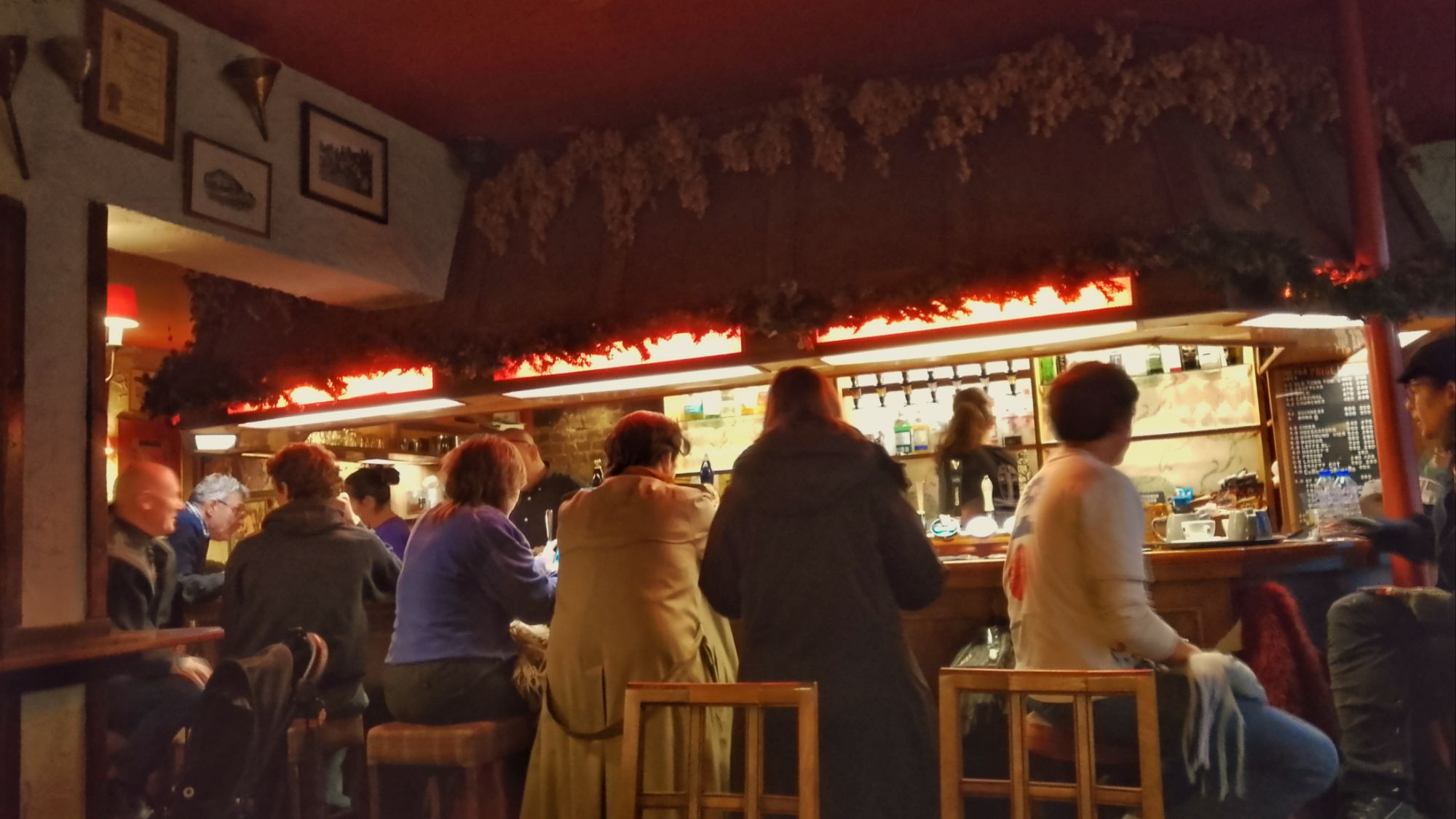
Several people sat at a pub bar, there is a glow behind the bar and a wooden fitting with lighting above. Hops hang from the ceiling.

I’m not sure I have enough to say on one pubby subject to justify a whole post, but thought maybe I could instead cobble a few things together – so this is either the first of a long-running series of disparate pub thoughts or a one-off experiment I will never speak of again. If it helps, just imagine me in the corner of an old boozer, rambling these thoughts to myself.

I went for a walk through London earlier this week, mainly around Bloomsbury and Fitzrovia, both areas not short of pubs. I noticed a couple of things. 

First, there seems to be the beginnings of a softening on eye-watering London prices. I saw a few different places either making a point of advertising they have at least one pint available for a fiver or offering some kind of Happy Hour promotion. Considering how prohibitive any kind of session has become in many London pubs this felt like a really positive step forward. I’ll happily try out a new pub for a fiver, I get more wary when somewhere new doesn’t clearly list their prices and I might be looking at a nasty surprise when they ring up my drink. These pubs, on the whole, seemed like nice ones too. It’s a really encouraging sign and I hope the trend continues – as much as I appreciate overheads are high, pubs do need to do more to meet drinkers halfway and give them a reason to step through the door. Having at least one pint at a reasonable price seems a good start, and a good principle for all pubs to have. 

Secondly, I saw a few pubs being renovated and several others that looked like they had recently been refitted. The trend seems to be to make places look a bit more “craft-y”, if that is actually a style of pub. I guess when I say that I mean some form of pseudo-restoration where the carpets are pulled up, the wood revarnished, tiling laid in various places and a general clear out of pub tat in favour of the odd bit of art or an old mirror. Someone has worked out that there is a certain visual identity that is appealing to drinkers right now and it is something that feels modern yet respectful, that is tasteful but not really homely. The kind of place I can admire but probably not love. The funny thing is that many of these places haven’t actually become craft pubs – they have all the aesthetics but none of the beer. More often than not the drinks selection is pretty uninspired, either the usual suspects or (at best) the most pedestrian craft-adjacent stuff. I guess this might be a brewery thing. 

Drinking more locally, on the unfashionable outskirts of London, I’ve noticed that London Prices have very much made it out here – and in some cases have been surpassed. £7 to £8 for something not hugely exciting has become the norm in some of the more fashionable/”upmarket” places. My suspicion is this is to weed out a certain kind of customer, as much as anything. 

However, we popped into a very unfashionable pub near us the other night and the prices weren’t so bad and there was a nice mix of people for somewhere that in the past has either been a bit dead or a bit “local pub for local people”. We took the dog along, and it was a reminder of how much a dog can be a great ice breaker when it comes to venturing in a pub where you aren’t known and aren’t sure what kind of welcome you’ll receive. The person behind the bar couldn’t do enough for our furry friend, the regulars made a fuss of her too and I guess in the process we showed we aren’t too awful either! 

Finally, I watched the 1969 documentary I Love This Dirty Town on iPlayer. Margaret Drabble laments what has happened to the city and decries the facelessness of the suburbs. There are plenty of arguments I imagine people would still agree with today, although I think I’m a little too attached to the suburbs to accept all her criticisms. But I certainly agreed with her words at the end of the film:

“Neighbourhoods need pubs in the same way they need a church to bring in people – in a word this is…Life”

Image from First In Last Out in Hastings, a lovely pub with a proper pub interior and a real community feel.
In praise of the pub queue

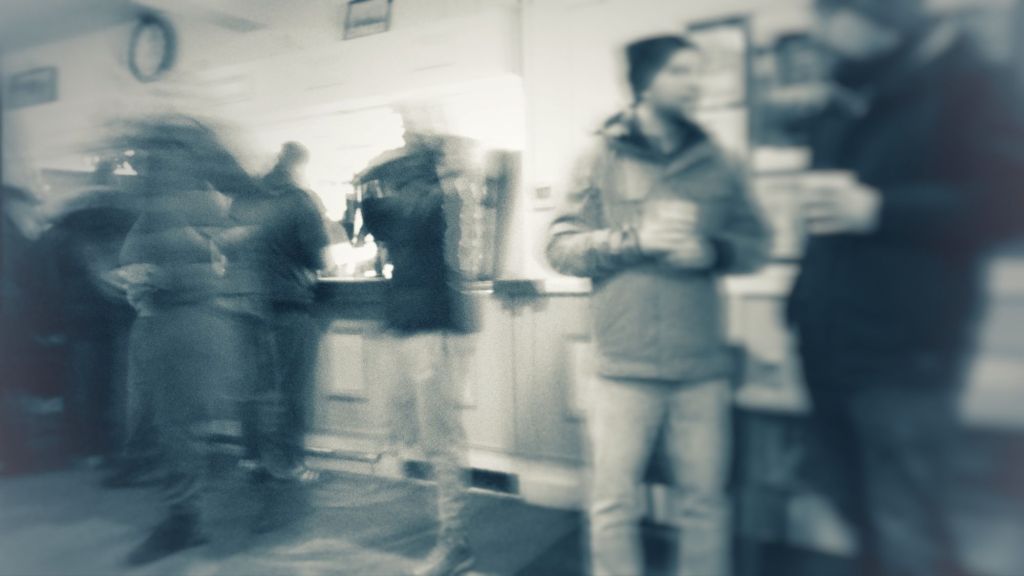
Blurred image of a bar, people are milling about, two men stand by the side with pints of beer

Last week and I was in a pub in Central London and it was packed. It was packed, but it wasn’t busy, which I appreciate probably doesn’t make much sense. There weren’t that many people there, especially for the Thursday night after-work drink slot. There were empty tables. There was room outside to enjoy the early Autumn evening sunshine. Back at the bar it was packed, uncomfortably so.

There were plenty of staff, but there were loads of people crammed around the bar. It was hard enough to navigate past, let alone to get a drink. And those who were successful getting served were then faced with a mass of humanity to navigate past with their drinks. It didn’t seem the ideal set-up.

Meanwhile, I’ve noticed this year that there’s been lots of grumbling around people queuing in pubs. Pubs and breweries are closing, the economy is making a night out a luxury rather than a routine, and yet people lining up for a drink appears to raise far more ire amongst a certain kind of pub-goer.

But…dare I say it…I think queues in pubs are fine…and sometimes even good?

I’m not quite sure why queues are such an issue. They can be annoying if they wind around seating areas, but then a scrum at the bar can be just as irritating and intrusive. A long bar might be wasted with a queue, but not if there’s only one or two bar staff working behind it. Crowd control is part of the art of running a pub, and a queue can work just as as well as anything else. If people like going to the bar (as opposed to getting table service) then surely their main focus is on getting them served as quickly as possible, rather than focusing on the formation in which they stand?

Queues guarantee that people are served in the order they arrived. As much as staff should be able to clock who is next, they have enough to do without keeping tabs on that. There are the bar-blockers who think that if they are standing at the bar then that means they should be served-on-demand no matter who else is waiting. There are the entitled regulars who think they have a fast pass to their usual. Then there are just the confident, the tall and the selfish. It is an unnecessary minefield for staff and drinkers alike.

Ultimately, I can see queues as a helpful tool, especially during busy periods, as the reality is many people will just not behave in pubs, and the current system benefits some people more than others. Pubs should be spaces for all, not just for those more able to navigate them.

In many pubs if you are white, male, able-bodied and known by the staff you have a significantly better chance of getting served than if you are none of those things. And considering pubs have traditionally not exactly been the most welcoming of places to those who aren’t white, male and able-bodied and are closing at a rapidly escalating rate you would think it would be in their interests (and in the interests of all pub regulars) to make it easier for the widest possible demographic to actually spend money in a pub.

My suspicion is the most vehement opponents of pub queues have simply never had an issue getting served themselves. And perhaps they might benefit from showing some empathy towards the kinds of people who regularly find it difficult, either getting jostled out the way, or overlooked by bar staff, or simply feeling uncomfortable in that kind of environment.

Pubs can be intimidating places, and getting served can be a big part of that. Some of the biggest issues I’ve had in pubs have involved people getting aggressive at the bar over who should be served next, or encountering problems from all the pushing and shoving on the way to and from the bar. I’m fortunate enough to feel reasonably comfortable handling all that, but I wouldn’t expect everyone to be.

Pubs need to adapt, and if the current system isn’t working then people will adapt themselves – most queues are spontaneous, not mandated. The economics of drinking mean a trip to the pub is more of a financial commitment than it has ever been. And if people are having to fight their way to pay a premium for a pint, they will soon look elsewhere to spend their hard-earned and rapidly diminishing cash.

The queue is egalitarian and deeply British. It’s not the answer in every pub. But in many pubs it just might be.

A beery firmament

Patrick Sullivan's Bar

As I worked on my review of Dušan Šarotar’s Panorama, I gathered quotations and I gathered reflections, and did my best to marry the two, one supporting the other. It took me back to my school days, my university days too, the point where writing feels more like brickwork than creativity, but generally an exercise where with a bit of thought and sweat you can produce something reasonably sturdy. Read the rest of this entry »

20th century pub

View from a pub table

The twentieth century pub is not just a public house, it is a public home. A home from home. An ideal home. A broken home. It is everything you could want from a home – a refuge, a retreat, a place to entertain, a place to be alone. A place that disappoints, that you grow out of, that you leave. It is somewhere you want to improve, somewhere you never want to change. It is an extension of our identity. A window into our likes, loves, weaknesses and strengths. It is who we are, for better, for worse, richer, poorer. A home.

This is a response to Boak and Bailey’s challenge/competition to write 100 words or so on the 20th century pub, which is also the subject of their latest book.

The Boar’s Head Inn, Crowborough

Exterior of The Boar's Head Inn, Crowborough

I sometimes wonder if the archetypal English country pub really exists. There are the country pubs turned gastropubs, country pubs turned children’s play centres with a pub attached, country pubs turned inwards for a select clientele and nobody else, country pubs turned into something else entirely.

Read the rest of this entry »

Design a site like this with WordPress.com
Get started