Wait until next year

Putting off what could be done tomorrow, today

The perfect game (My Baseball Winter #2)
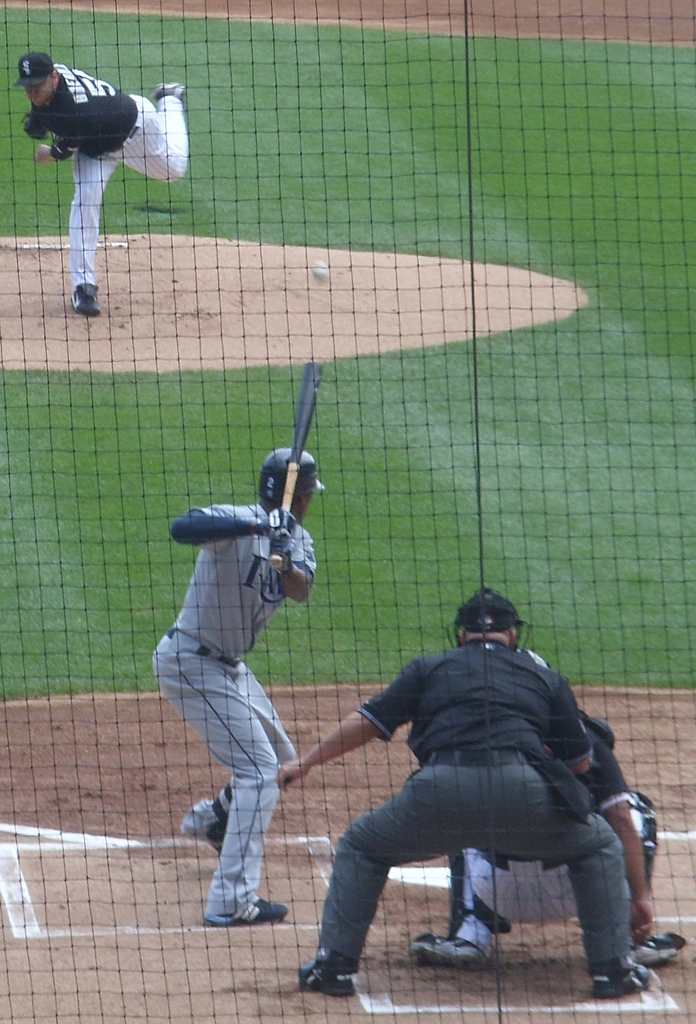
So, following on from my intro to My Baseball Winter I thought I’d actually start chronicling my Wintertime baseball experiences. This is not in chronological order, so unfortunately my ‘journey’ may end up a rather fragmented one. I think I may end up offering these snapshots and hope that they add up to, well…something beyond the sum of their parts. Before I begin, a tiny bit of context. I recently tried scoring my first game (thoughts and scans to come in the near future, all being well). I’ve also been perusing last season’s stats. Generally with a confused expression on my face. OK, well, let us finally get this blog post started…

Sport doesn’t really matter. We could function as human beings without it. I hear that some people even do. Just as some people function without music, literature, art or any of that other useless stuff.

But boy, life would be empty without all those things. Especially sport.

While ‘art’ can, and does, engineer moments that transcend the everyday, sport doesn’t. But it still happens, from time to time. By chance, and as a wonderful by-product of the technique of those involved and of the contest itself. And that’s what makes sport magical.

That sometimes it can make us feel alive, without even trying.

On July 23 this year Mark Buehrle of the Chicago White Sox threw only the eighteenth perfect game in Major League Baseball history, and only the sixteenth since 1900. This is perhaps the ultimate act in the sport of baseball. To throw a perfect game a pitcher must, over the course of a nine inning game, allow no opposing player on to base.

This might not sound that impressive to someone new to baseball, but let’s think about this a second. This has happened on only eighteen occasions, in thousands and thousands of games. Bear in mind there are just short of 2,500 games played a year. So, in well over a quarter of a million games (if my shaky, hurried Maths is right), each starting with two pitchers (one a side), a perfect game has only been pitched those few times. July 23 really was a historic day.

So, as part of my ongoing baseballing education, I decided to sit through Buehrle’s famous innings. And I was struck by how much sport, this wonderful, useless pastime, can mean. Genuinely, there was a beauty in Buehrle’s performance, as it unfolded. Even though I knew the outcome, I was still overcome with tension and emotion on each pitch.

I think this was because the ‘perfect game’ isn’t entirely perfect. Bear with me here. Each pitch isn’t a strike, with the batter missing the ball. Some batters hit the ball, only for the ball to drop into foul territory. A matter of a couple of inches keeps the game ‘perfect’.

Some batters make contact with the ball but are out before they reach first base. Some balls are struck into the field, only to be caught. In the most dramatic moment of the game, in the ninth and final inning, the substitute fielder Dewayne Wise somehow juggled the ball from his gloved hand to bare hand as his body hit the outfield wall. His skill kept Buehrle ‘perfect’.

And that’s what makes the perfect game so fascinating. While the pitcher might look lonely on the mound, he is never truly alone. The perfect game only happens if his fielders can support him. Watching the game, each catch and each piece of fielding, to remove an opponent, takes on a real significance in hindsight.

What at first appears to be an individual milestone, proves to be the work of a team in perfect harmony in one particular game. How often do we really see that in sport, or, indeed, in life? Yet, on just a regular, run-of-the-mill day, this happened.

There’s the special thing about sport. It can be memorable, touching, moving, important at any time. This was just another afternoon game in another season, until events unfolded. Every game in every sport has the potential to be historic, or to bring joy to its participants or observers. Whenever we turn up or tune in, something incredible might be on the horizon. This was a great example of this. Perhaps this is why we cling to sport and stick with it no matter what disappointment it may throw at us.

Sport shows us that on any given day something amazing could happen to us.

Photo from The People’s Tribune via Twitter

Christmas shopping – tomorrow is my date with destiny

Christmas is coming!

I’m really quite excited about Christmas this year. In previous years I fell into the trap of going ‘bah humbug’ until it was too late, and only feeling truly Christmassy by Boxing Day. Which is obviously no good at all.

So, in the past couple of years I’ve gone for it. This year is no exception. My life is currently soundtracked by Christmas songs, I’m chomping at the bit to decorate the flat, and my advent calendar is being opened at regular intervals.

However, there is one aspect I’m wary about, and that is Christmas shopping.

On the one hand, I work right behind London’s Oxford Street, one of the world’s most famous shopping thoroughfares. However, that also means it is one of the busiest. It’s not much fun negotiating the shoppers and tourists at the best of times, let alone Christmas.

Despite this, tomorrow I will brave Christmas shopping in London.

Like the typical, stereotypical male, I have no list and few real plans. But I’m going to do it, anyway. I’m psyching myself up for the task. I may well plot a route, from shop to shop and back again. Or I might just wing it, like the maverick, loose cannon, play-my-my-own-rules shopper that I am.

I may, of course, decide to abort the mission after an hour and go to the pub, convincing myself that I was just ‘scouting out options’.

So, why don’t I just order online? One – I’m not that organised. For most people I haven’t a clue what to get. Generally I leave shopping far too late, although this is probably the earliest date in living memory for me to start Christmas shopping (I used to leave it until Christmas Eve, but I haven’t the nerve for that anymore). Two – shopping online is just not the same.

As much as Christmas shopping can be a stressful and distressing experience, secretly, I think it can also be a lot of fun. Weaving my way around busy streets, bags of presents in hand, is sure to get me in the Christmas mood. And that’s just what I’m looking for.

A further report may follow in the coming days, depending on how well (or badly) it goes. In the meantime, how is your Christmas shopping going? And any tips on making the shopping more fun, or more constructive?

John Lennon’s death, 29 years on

Steven’s post reminded me that today/yesterday is/was the 29th anniversary of John Lennon’s death.

I was but a baby when Lennon was killed, and so I can’t offer any memories on that day. However, that does mean I was born during a period where the Beatles permeated everything. Parents and teachers were fans, and so the music was there at home (via the records) and at school (where Beatles songs were a handy resource for trendier music teachers). There was no escape, not that I was looking for one.

And as I grew older, the Beatles were a constant reference point, as most bands I cared about would mention them. Without the Beatles, popular music wouldn’t have progressed as it did. That’s not hyperbole, that’s fact. Even if I had doubts over some of their work, I had to respect their influence, and certainly loved many of their songs.

This year, through the remastered versions, I’ve continued my Beatles odyssey and especially loved all the non-hits. Maybe the one problem with the Beatles is their ubiquity. Nothing sounds new if you’ve grown up with the songs. So, to hear the lesser-known album tracks has been wonderful, and the closest I’ll come to experiencing the thrill there must have been in the 60s listening to a new Beatles track for the first time.

Lennon’s death was obviously tragic. One strange side-effect for me is that the complexity of his character has, by many, been glossed over, in favour of some sort of martyrdom, as has happened for many rock/pop stars who died before their time. I think this does the man a disservice.

Someone so caustic and witty shouldn’t be beyond criticism and proper analysis, as some sort of ‘Saint John’. Hopefully I’m not just setting up a straw man argument here, and certainly don’t intend to be inflammatory on this anniversary. But, while he played a part in some of the greatest music of the twentieth century, there is more to him than that. Acknowledging lesser examples of his work and other aspects of his character are just as important to understanding the genius he had.

But, first and foremost, boy, could he write a tune. And listening to ‘Twist and Shout’ he couldn’t half belt out someone else’s tune too.

Why being in the World Cup Group of Death need not be a bad thing

Incredibly out-of-date post shocker! Last Friday saw the draw for next summer’s World Cup. I won’t go into a group-by-group preview just yet, although I will say England got off with an awfully easy draw. No disrespect to the USA, Algeria and Slovenia, but if England fail to qualify for the second phase I’ll eat my hat.

However, not every nation got off so likely. As in every major international football tournament draw, talk inevitably fell to that old reliable subject, “What group is the Group of Death?”. What was the toughest group, with the strongest sides and the best chance to see a contender knocked out in the first round?

This World Cup we have two contenders. Group D pits Germany against Australia, Ghana and Serbia, while Group G sees Brazil face Portugal, Ivory Coast and North Korea. Whatever way you look at it, those groups are tough. But is it the end of world? Far from it.

I’d like to say that I’ve undertaken a rigorous statistical exercise, but I can’t lie to you folks. I just looked up Group of Death on Wikipedia (since edited, sadly), and unearthed (or is that over-egging the pudding?) something interesting. Should a country survive the so-called Group of Death, they stand a pretty good chance of progressing well in the competition, if not winning it all.

In 2006 Italy had to get past Ghana, the Czech Republic and the United States. That they did, and then they went on to win the World Cup. In years gone by Argentina in 1978, Brazil in 1970, England in 1966 and Brazil in 1958 all negotiated incredibly difficult groups on their way to winning the World Cup. So, for every major side that has failed to survive (Argentina in 2002, Spain in 1998), there is a side that has gone on and prospered.

I’d suggest that this is perhaps the footballing equivalent of “what doesn’t kill you makes you stronger”. If a team qualifies from a tough group it is already primed and ready for truly competitive football. Playing against other strong sides is a much better preparation for knock-out football than playing a minnow. What better way to build momentum?

And so, and boy am I going out on a limb here, don’t be surprised if Brazil do well next summer. And Germany too. Hah! You don’t get insight like that anywhere else, eh?

The Great Gatsby – or is he?

More often than not I will lay off the fiction when I’m choosing a book. For faintly ridiculous reasons, really. I like to know what’s really going on in the world, or has gone on in the world in the past. I like reality. I like facts and information I can utilise in a pub quiz (how sad, eh?). I like tidbits I can bore my friends and family with on high days and holidays.

This is, of course, forgetting that you can get all this, and more, from good fiction. I can find out just as much, and be just as moved, as I would be by a true-life story.

This was certainly the case with F Scott Fitzgerald’s The Great Gatsby. After reading Hemingway’s A Moveable Feast, which features Fitzgerald around the time The Great Gatsby was written, the novel itself seemed a sensible next stop. Here I could perhaps flesh out that 1920s world, and see if Hemingway was right about this being Fitzgerald’s best work.

It did also help that the book is my Significant Other’s favourite. She has pretty good taste (well, she lives with me, right? OK, apart from living with me, she has good taste) and I doubted she’s recommend a book I wouldn’t go for.

You’ll be pleased to hear, dear reader, I wasn’t disappointed.

Here is a wonderful snapshot of 1920s decadence. Here was that sense of freedom and abandon after the First World War. Here was the truly modern(ist?) world, with its pleasures and its pitfalls. The book chronicles the recklessness of the age, which would eventually lead to the Wall Street Crash and the Great Depression (although obviously Fitzgerald was not to know of this when he was writing the book). People wallow in excess, on money that appears from nowhere, with no foundation, a modern Gomorrah, heading for disaster. Sounds familiar, eh?

Money is no object, and with Gatsby, he appears to have magicked it from thin air. The allusion is that he has gained his fortune by nefarious means (perhaps he is a con artist, perhaps a bootlegger, perhaps a fixer of the World Series). But the great and good are more than happy to accept his charming self, and more importantly are happy to see his money spent on their own enjoyment, at his countless parties. No questions asked.

I found Gatsby such a fascinating character as he does not seem of this (that?) world. He is a mirage. He seems to have appeared from nowhere, and can disappear just as quickly.

In the early passages of the book, Gatsby is but a mythical presence. The narrator, Nick Carraway, hears of him but does not meet him, despite living next-door. When he first catches sight of him, he vanishes. When they first meet face-to-face, Nick does not immediately realise who he is talking to.

Here is a character who is dropped into the ‘normal’ world and seems to unsettle everything. Yet, by the end, on the surface, normality has returned, or at least the unrest has been suppressed. This lends Gatsby an almost ghostly,dream-like air. For the main characters, to the outside world at least, it is as if nothing has ever happened. The status quo is restored.

He is soon forgotten by high society. They move on. Those who he genuinely touched will at least pretend to forget him, or wish that they could. Only Nick remains to mark and remember Gatsby. And so, Gatsby starts and ends a myth. He lives only in Nick’s words and memory.

Was Gatsby an illusion? Just as all that surrounded him was, and as the riches of that time were? It seems that way.

Design a site like this with WordPress.com
Get started